 Post by
 ChatGPT Launches Paid Advertising: What Does This Mean for Digital Marketing?
Artificial intelligence is changing the way people search for information, discover brands, compare products, and make purchasing decisions. One of the biggest developments in this rapidly changing digital landscape is the introduction and expansion of advertising within ChatGPT.
For years, businesses have relied on platforms such as Google, Facebook, Instagram, YouTube, and other advertising networks to reach potential customers. Now, AI-powered conversational platforms are becoming another important part of the digital customer journey.
ChatGPT’s advertising capabilities could create a new opportunity for brands to reach consumers while they are actively asking questions, researching solutions, comparing products, and exploring recommendations.
For digital marketing agencies and businesses, this raises an important question:
What does ChatGPT paid advertising mean for the future of digital marketing?
The answer is potentially significant.
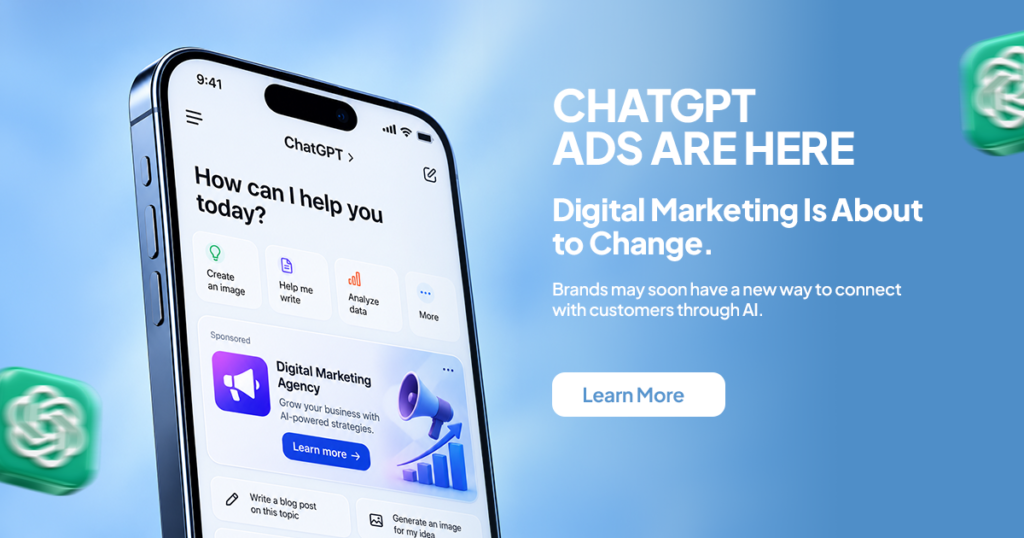
What Is ChatGPT Advertising?
ChatGPT advertising refers to sponsored advertising experiences within ChatGPT that allow businesses to promote products or services to relevant users.
Traditional search advertising is primarily built around keywords and search queries. ChatGPT introduces a different environment because users communicate with AI using natural language.
For example, instead of searching:
a potential customer might ask:
“I run a small eCommerce business in the USA. How can I increase organic traffic and generate more online sales?”
This provides significantly more contextual information about the user’s problem, needs, and potential intent.
For marketers, this creates the possibility of advertising in an environment where customer conversations can provide richer context than a short keyword.
Why ChatGPT Ads Could Be a Major Change
The biggest change is not simply another advertising placement.
It is the combination of AI + intent + conversation + advertising.
Traditional advertising often requires marketers to predict what customers are searching for.
Conversational AI can understand the broader context of what a person is asking.
Consider these two searches:
Traditional search:
“CRM software”
Conversational search:
“I own a real estate company with 10 sales agents. We receive leads from WhatsApp, email, property portals, and our website. What type of CRM should we use?”
The second query contains substantially more information.
This could help create more relevant advertising and customer experiences.
ChatGPT Ads and the Changing Customer Journey
The traditional digital customer journey often looks like:
Search → Advertisement → Website → Product/Service → Conversion
The AI-driven customer journey may increasingly look like:
Question → AI Conversation → Research → Comparison → Discovery → Website → Conversion
This difference is extremely important for marketers.
Customers may interact with AI several times before they ever visit a company’s website.
Therefore, businesses need to think about their visibility before the website visit, not just after it.
ChatGPT Ads vs. Google Ads
ChatGPT Ads and Google Ads should not necessarily be viewed as direct replacements for each other.
They serve different environments.
| Google Ads | ChatGPT Advertising |
|---|---|
| Keyword-driven | Conversation-driven |
| Search results | AI conversation environment |
| Strong focus on search intent | Strong focus on conversational context |
| Text, shopping, display formats | AI-oriented advertising experiences |
| Search-to-website journey | Conversation-to-discovery journey |
| Mature advertising ecosystem | Emerging advertising opportunity |
Google remains extremely important for businesses.
However, as AI changes consumer behavior, marketers should consider how their strategies can work across traditional search and AI-powered discovery.
What Does This Mean for PPC Marketing?
Pay-per-click advertising has traditionally focused on platforms such as Google and Microsoft Ads.
ChatGPT’s advertising model introduces another potential PPC environment.
For marketers, this could mean:
- More advertising channels
- New audience opportunities
- New bidding strategies
- New performance benchmarks
- Different creative requirements
- New conversion journeys
- Greater importance of contextual relevance
Instead of optimizing only for keywords, marketers may increasingly need to understand customer questions and conversational intent.
The Importance of Customer Intent
Intent has always been important in digital advertising.
But AI makes understanding intent even more important.
Consider the difference between:
and:
“I need a digital marketing agency to generate leads for my B2B software company in the USA. What services should I consider?”
The second query provides information about:
- Business type
- Location
- Marketing objective
- Customer requirement
- Potential buying intent
This type of contextual information can help marketers create better campaigns and landing pages.
How ChatGPT Advertising Could Affect SEO
One common question businesses may ask is:
Will ChatGPT Ads replace SEO?
No.
SEO will continue to be important because organic visibility provides long-term value and doesn’t depend exclusively on advertising budgets.
However, SEO itself is changing.
Businesses now need to consider visibility across:
- Google Search
- Bing
- AI search
- ChatGPT
- Business directories
- Social media
- Review platforms
- Industry publications
- Local search
- Online communities
This means businesses should develop an integrated search visibility strategy.
SEO Is Moving Toward AI Search Visibility
Traditional SEO focuses heavily on ranking webpages for search queries.
AI search optimization focuses more broadly on helping search and AI systems understand:
- Who your business is
- What services you provide
- Which locations you serve
- What problems you solve
- Why customers should trust you
- What makes your business different
This makes high-quality content, structured information, brand mentions, reviews, and authoritative websites increasingly important.
AEO and GEO Are Becoming Important
Businesses should also pay attention to emerging approaches such as:
AEO — Answer Engine Optimization
and
GEO — Generative Engine Optimization
The objective is to increase the likelihood that a brand’s information can be understood and surfaced by AI-powered search and answer systems.
For example, instead of only targeting:
“SEO company in Mohali”
a business can create content around questions such as:
- What does an SEO company do?
- How much does SEO cost?
- How long does SEO take?
- What is local SEO?
- How can businesses generate leads through SEO?
- How does AI affect SEO?
This creates a broader content ecosystem around the business.
Content Marketing Will Become Even More Important
AI advertising does not eliminate the need for content.
In many ways, it makes high-quality content more important.
Businesses should publish:
- Detailed service pages
- Educational blogs
- FAQs
- Case studies
- Industry guides
- Comparison articles
- Customer success stories
- Local content
- Expert insights
- Original research
The objective should not be simply producing hundreds of AI-generated articles.
The objective should be creating useful, original, trustworthy content that genuinely helps customers.
AI Advertising Will Not Replace Human Strategy
AI can help automate many marketing activities, but strategy remains essential.
A successful advertising campaign still requires marketers to understand:
- Target customers
- Business objectives
- Customer pain points
- Competitive positioning
- Pricing
- Offers
- Brand messaging
- Conversion goals
- Landing pages
- Sales processes
AI can accelerate execution, but businesses still need a clear strategy.
What Businesses Should Do Before Investing in ChatGPT Ads
Before testing a new advertising channel, businesses should make sure their digital foundation is strong.
1. Optimize Your Website
Your website should be fast, mobile-friendly, secure, easy to navigate, and designed for conversions.
2. Build Strong Landing Pages
Every advertising campaign should ideally lead to a relevant landing page rather than a generic homepage.
3. Define Your Audience
Know exactly who you want to reach.
4. Develop Strong Offers
Give customers a clear reason to take action.
5. Improve Your Content
Create content that answers the questions customers are actually asking.
6. Track Conversions
Measure leads, sales, calls, forms, and other meaningful actions.
7. Continue SEO
Don’t abandon organic search while experimenting with AI advertising.
How ChatGPT Ads Could Benefit Small Businesses
Small businesses often struggle to compete with large brands because advertising costs can become expensive.
AI-powered advertising could potentially provide another way to reach highly relevant audiences.
For example, a local:
- Dentist
- Real estate company
- Travel agency
- SaaS company
- Law firm
- Marketing agency
- eCommerce store
- Web development company
could potentially reach customers during relevant research conversations.
However, advertising success will still depend on budget, competition, offer quality, targeting, creative, website experience, and conversion rates.
Example: Digital Marketing Agency
Imagine someone asks:
“What is the best way to generate leads for my small business in the USA?”
The conversation may continue:
User: I have a $2,000 monthly marketing budget.
AI: You could consider SEO, paid search, social media advertising, and content marketing.
User: Which service should I start with?
This is a valuable moment in the customer journey.
A relevant sponsored advertising experience could potentially introduce a suitable business or service while the user is actively considering solutions.
This is fundamentally different from showing an advertisement to someone who may have little or no interest.
What This Means for Digital Marketing Agencies
Digital marketing agencies need to evolve along with the platforms their customers use.
Agencies may increasingly need expertise in:
- Traditional SEO
- AI search optimization
- Paid advertising
- ChatGPT Ads
- Content marketing
- Conversion optimization
- Social media
- Analytics
- Brand visibility
- Reputation management
- AI-assisted marketing
The future will not be about choosing SEO or AI.
It will be about combining multiple digital channels intelligently.
How DS Solution Can Help Businesses Adapt
DS Solution helps businesses build a stronger and more effective digital presence through a combination of digital marketing services.
Our services can include:
SEO Services
Improve organic search visibility through technical SEO, on-page optimization, content strategy, local SEO, and link-building strategies.
Paid Advertising
Develop performance-focused campaigns designed around traffic, leads, sales, and measurable business objectives.
Social Media Marketing
Build brand awareness and customer engagement across relevant social platforms.
Website Design & Development
Create professional, mobile-friendly, user-focused websites designed to support both SEO and conversions.
Content Marketing
Develop useful content that answers customer questions and supports organic and AI-driven visibility.
Local SEO
Help local businesses improve their visibility across local search and business listings.
AI & Digital Marketing Strategy
Adapt digital marketing strategies to the changing AI-powered search environment.
Why Businesses Need an Integrated Strategy
Imagine investing heavily in paid advertising but sending visitors to a slow website.
Or investing in SEO but having poor conversion rates.
Or creating excellent content but having no distribution strategy.
Each marketing channel depends on the others.
A successful digital marketing strategy should connect:
SEO + PPC + Content + Website + Social Media + Analytics + AI Visibility
This creates a stronger marketing ecosystem.
The Future of Digital Marketing
The next generation of digital marketing will likely become increasingly automated, conversational, personalized, and AI-driven.
Consumers will continue using AI to:
- Research products
- Compare services
- Find businesses
- Ask for recommendations
- Plan purchases
- Solve problems
- Discover brands
Advertisers will therefore need to understand not only where customers search, but also how customers ask questions.
This is a major strategic shift.
Frequently Asked Questions
Is ChatGPT launching paid advertising?
Will ChatGPT Ads replace Google Ads?
Will ChatGPT Ads affect SEO?
Should small businesses advertise on ChatGPT?
What services does DS Solution provide?
Conclusion
ChatGPT paid advertising could represent an important new chapter in digital marketing.
The biggest change isn’t simply that businesses can advertise on another platform. The bigger opportunity comes from advertising within an environment where users are already asking questions, researching solutions, and exploring their options.
For businesses, this means the future of digital marketing will require more than traditional keyword targeting.
Brands need to understand customer intent, conversational search, AI visibility, content quality, paid advertising, and conversion optimization.
At DS Solution, we believe businesses that combine traditional digital marketing fundamentals with emerging AI opportunities will be better prepared for the future.
Want to make your business more visible in the changing digital landscape? Contact DS Solution for SEO, paid advertising, website design, social media marketing, content marketing, and AI-focused digital marketing strategies.