
 Post by
 How to Get Your Business Found on Google in 2026: A Complete SEO Guide for U.S. Small Businesses
For a small business in the United States, being visible on Google can make a major difference in how potential customers discover your products or services. Whether someone searches for a local service, compares businesses, checks reviews, or looks for a solution to a problem, Google is often one of the first places they turn.
But getting found on Google in 2026 requires more than simply adding keywords to a website.
Businesses need a combination of search engine optimization (SEO), local SEO, high-quality content, Google Business Profile optimization, technical website improvements, online reputation management, and a strong user experience.
In this guide, DS Solution explains practical ways U.S. small businesses can improve their Google visibility and build a stronger online presence.
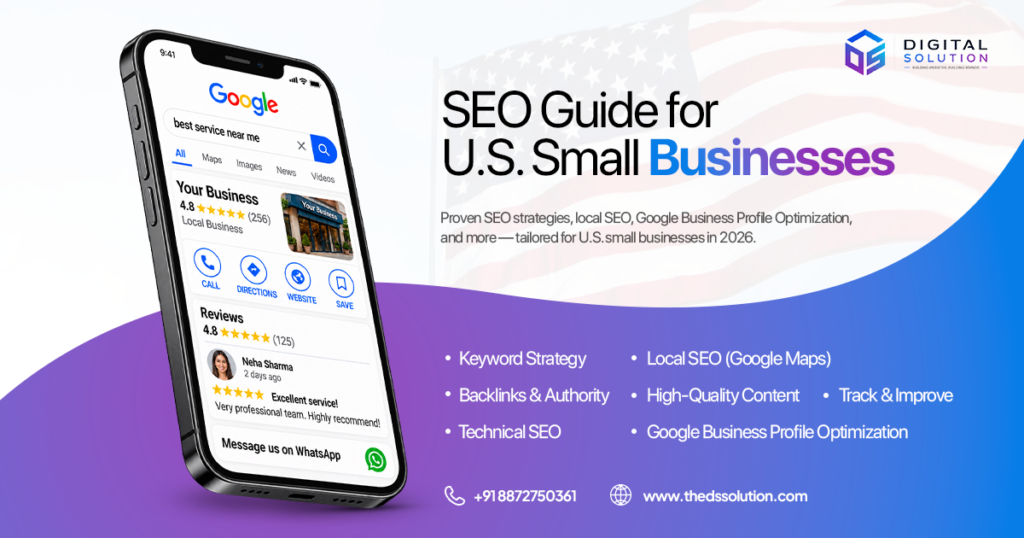
Why Google Visibility Matters for U.S. Small Businesses
A business can have excellent products and services, but if potential customers cannot find it online, opportunities can be lost.
Google visibility can help businesses:
- Reach customers who are actively searching for their services
- Generate qualified website traffic
- Increase calls, inquiries, and form submissions
- Improve local discovery through Google Maps
- Build brand awareness
- Establish online credibility
- Generate leads without relying entirely on paid advertising
The goal isn’t simply to rank for one keyword. A successful SEO strategy should help your business become visible for the different searches your potential customers make throughout their buying journey.
1. Start With a Strong SEO Foundation
Before trying advanced SEO strategies, make sure your website has a solid foundation.
Your website should clearly communicate:
- What your business does
- Which products or services you provide
- Who you serve
- Where you operate
- Why customers should choose you
- How customers can contact you
Every important service should have a dedicated, useful page rather than placing everything on one generic page.
For example, instead of creating one page called “Our Services,” a marketing company could have separate pages for:
- SEO Services
- Local SEO
- PPC Management
- Web Design
- Web Development
- Social Media Marketing
- Content Marketing
This makes it easier for both users and search engines to understand the website.
2. Optimize Your Google Business Profile
For businesses serving a specific geographic area, Google Business Profile is an important part of local SEO.
Google says businesses should keep their Business Profile information complete and accurate. Local results are primarily influenced by relevance, distance, and prominence.
Make sure your profile includes accurate:
- Business name
- Primary category
- Address or service area
- Phone number
- Website
- Business hours
- Services
- Business description
- Photos and videos
Keep your information updated when something changes.
A complete profile doesn’t guarantee a particular ranking position, but it gives Google better information about your business and helps customers understand what you offer.
3. Target the Right Keywords
Keyword research remains an important part of SEO, but the focus should be on search intent, not simply repeating high-volume keywords.
Consider the different types of searches your customers might make.
Informational searches
Examples:
- How does local SEO work?
- How can I improve my website ranking?
- What is digital marketing?
Commercial searches
Examples:
- Best SEO company for small business
- Local SEO services near me
- Website design agency for small businesses
Transactional searches
Examples:
- Hire SEO agency
- Book web design consultation
- SEO services for small business
Local searches
Examples:
- SEO company in Chicago
- Web designer near me
- Digital marketing agency in Dallas
Create content that matches each type of search instead of trying to make one page rank for everything.
4. Create Helpful, Original Content
One of the most effective ways to build long-term organic visibility is to consistently publish useful content.
Instead of creating articles solely to target keywords, answer questions your customers genuinely ask.
Good content should be:
- Original
- Useful
- Easy to understand
- Relevant to your target audience
- Accurate
- Well organized
- Written for people first
Avoid publishing dozens of thin articles that provide little additional value.
5. Build Local SEO Signals
If your company serves customers in specific U.S. cities or regions, local SEO should be part of your strategy.
Create genuinely useful location-focused pages where appropriate.
For example:
Digital Marketing Services in Austin
should not simply be a copy of:
Digital Marketing Services in Dallas
with the city name changed.
A useful location page can include:
- Services available in that area
- Local customer needs
- Relevant examples or projects
- Service-area information
- Frequently asked questions
- Local testimonials where appropriate
- Useful local information
The objective is to provide genuine value to customers in that location.
Google notes that local prominence can be influenced by information across the web, including links, articles, directories, and reviews.
6. Earn Genuine Customer Reviews
Reviews can influence how customers perceive your business and are also one of the signals Google considers when determining local prominence.
Encourage satisfied customers to leave honest reviews.
More importantly, respond professionally to reviews.
A good response should:
- Thank the customer
- Address their feedback
- Remain professional
- Avoid repetitive keyword stuffing
- Show that your business values customer experience
Never create fake reviews or manipulate your reputation.
Authenticity matters.
7. Improve Your Website's Technical SEO
Great content won’t perform as well if search engines or users struggle to access your website.
Review important technical areas such as:
Mobile usability
Your website should work properly on smartphones and tablets.
Page speed
Pages should load efficiently without unnecessary scripts, images, or other technical issues slowing the experience.
HTTPS
Use a secure HTTPS connection throughout the website.
Crawlability
Make sure important pages can be discovered and crawled by search engines.
Internal links
Connect related pages so users and search engines can easily discover important content.
XML sitemap
Maintain an accurate sitemap that helps search engines discover your pages.
Broken links
Regularly identify and fix broken internal and external links where appropriate.
Technical SEO is not about making a website complicated. It’s about making the website easier for both people and search engines to use.
8. Optimize Your On-Page SEO
Every important page should have a clear topic and structure.
Pay attention to:
- SEO title
- Meta description
- Main heading
- Subheadings
- URL structure
- Relevant keywords
- Internal links
- Image alt text where appropriate
- Clear calls to action
For example, instead of:
example.com/page123
a descriptive URL might be:
example.com/local-seo-services/
Don’t force keywords into every sentence. Use natural language and related terminology that helps explain the subject.
9. Build Authority With Quality Links and Mentions
Links from relevant and trustworthy websites can help search engines discover and understand your website and can also send referral traffic.
For U.S. small businesses, opportunities may include:
- Local business organizations
- Industry associations
- Relevant publications
- Local news websites
- Business directories
- Community organizations
- Partner businesses
- Industry blogs
Focus on relevance and quality rather than collecting hundreds of low-quality links.
A smaller number of meaningful mentions can be more useful than a large collection of unrelated links.
10. Use Structured Data Where Appropriate
Structured data helps communicate certain information about a page to search engines in a standardized format.
For businesses, LocalBusiness structured data can communicate information such as business details and operating hours. Google provides specific documentation for implementing LocalBusiness structured data.
Depending on your website, you may also consider appropriate structured data for:
- Organization
- LocalBusiness
- Product
- Article
- Breadcrumbs
Structured data does not guarantee higher rankings or a rich result. It should accurately represent the content visible on the page and follow Google’s guidelines.
11. Optimize for Users, Not Just Search Engines
SEO should ultimately support the customer experience.
When someone lands on your website, they should quickly understand:
What do you offer?
Can you solve my problem?
Why should I trust you?
What should I do next?
Use:
- Clear headings
- Short paragraphs
- Helpful visuals
- Simple navigation
- Strong calls to action
- Easy-to-find contact information
- Trust signals
- Useful FAQs
A visitor shouldn’t have to search through five pages to figure out how to contact your business.
12. Think Beyond Traditional Google Results
Search behavior continues to evolve.
People increasingly interact with search through different experiences, including AI-powered features and conversational tools.
That means businesses should focus on creating content that clearly answers real questions and demonstrates expertise.
Instead of writing content only around:
“SEO services”
you can also create useful resources such as:
- How does SEO help small businesses?
- How long does SEO take?
- How much does local SEO cost?
- What should a small business SEO strategy include?
- How can a local business get more Google visibility?
The same high-quality information can potentially help your brand become more discoverable across different search experiences.
13. Track Your SEO Performance
You cannot improve what you don’t measure.
Use tools such as Google Search Console and analytics platforms to monitor:
- Organic clicks
- Impressions
- Search queries
- Click-through rate
- Indexed pages
- Organic landing pages
- Leads
- Conversions
- Local visibility
- Website engagement
Don’t judge SEO only by keyword rankings.
A ranking improvement is useful, but the bigger question is:
Is organic search helping the business generate meaningful results?
14. Avoid Common SEO Mistakes
Many small businesses make SEO harder than it needs to be.
Avoid:
Keyword stuffing
Repeating the same keyword unnaturally can make content difficult to read.
Duplicate content
Creating multiple nearly identical pages can provide little value.
Buying questionable backlinks
Low-quality link schemes can create unnecessary risk.
Fake reviews
Fake reviews damage trust and violate platform policies.
Creating pages for every city without unique value
Location pages should exist because they serve a genuine audience—not simply because a city name has been added to a template.
Ignoring mobile users
A large portion of online activity happens on mobile devices, so mobile usability matters.
Publishing content without a strategy
More blog posts don’t automatically mean more traffic.
Focus on useful content that supports your customers and your business goals.
A Simple 2026 Google SEO Checklist for U.S. Small Businesses
Use this checklist to review your current SEO strategy:
☐ Google Business Profile is claimed and verified
☐ Business information is accurate and complete
☐ Website is mobile-friendly
☐ Website uses HTTPS
☐ Important service pages exist
☐ Target keywords match search intent
☐ Website pages have descriptive titles
☐ Content answers real customer questions
☐ Internal linking is organized
☐ Broken links are monitored
☐ XML sitemap is available
☐ Search Console is configured
☐ Customer reviews are encouraged authentically
☐ Reviews receive professional responses
☐ Relevant local/industry mentions are being developed
☐ Website performance is monitored
☐ Leads and conversions are tracked
☐ Content is updated when information becomes outdated
Final Thoughts
Getting your business found on Google in 2026 isn’t about discovering one secret ranking trick.
It’s about building a strong, useful, trustworthy digital presence.
For U.S. small businesses, that means combining SEO, local SEO, Google Business Profile optimization, helpful content, technical SEO, reputation building, website usability, and ongoing measurement.
Google’s own guidance makes clear that local visibility depends primarily on relevance, distance, and prominence, while complete and accurate business information helps Google understand and match a business to relevant searches.
The best SEO strategy is therefore not simply to chase rankings. It is to make your business easier to find, understand, trust, and contact.
How Digital Solution Can Help
At Digital Solution, we help businesses strengthen their online presence through SEO, digital marketing, web design, web development, local SEO, and other digital solutions.
Whether you are launching a new website or trying to increase organic visibility, a strategic SEO approach can help you build a stronger foundation for sustainable online growth.
Ready to improve your online visibility? Connect with DS Solution and start building a smarter digital presence.